Executive summary
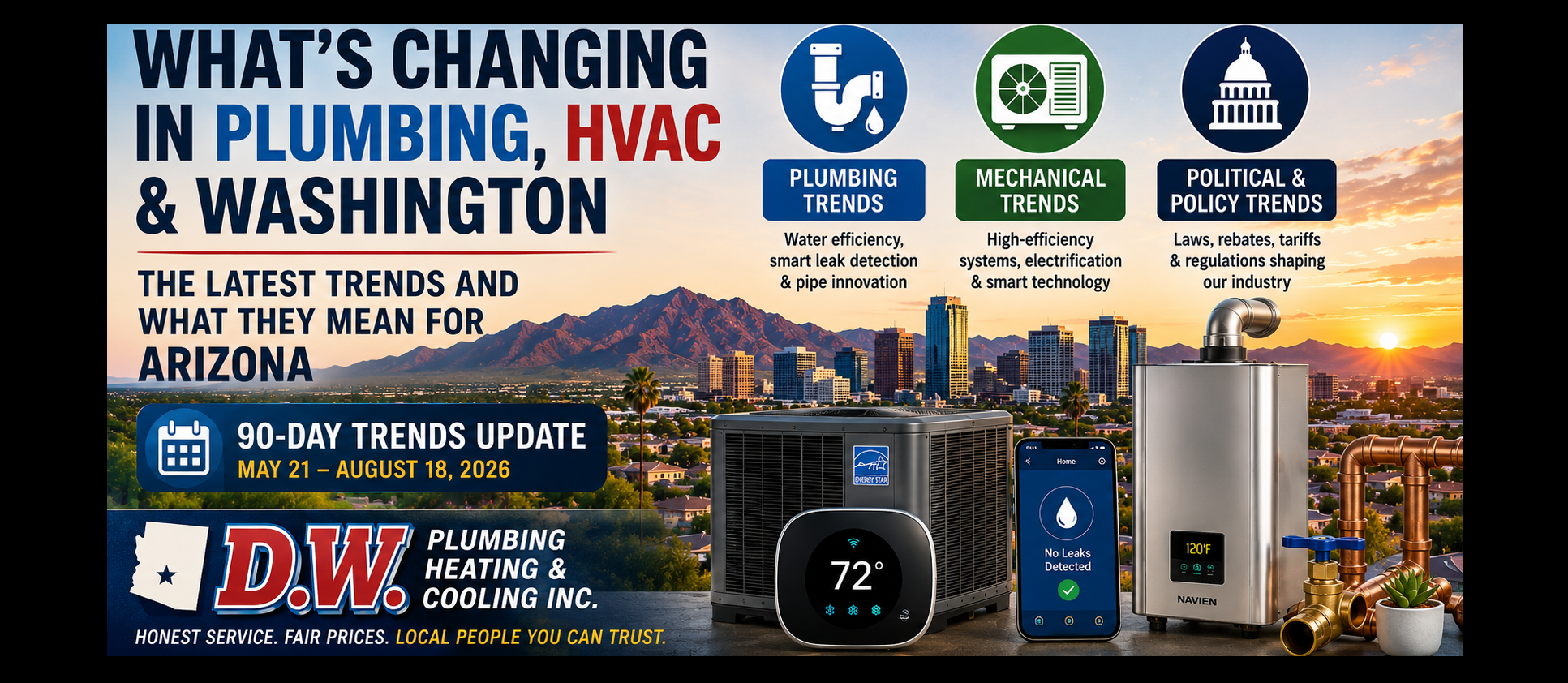
Research window: May 20, 2026 through August 18, 2026, using a rolling 90-day period ending August 18, 2026 in America/Phoenix. Because a rolling 90-day interval begins partway through May 20, I include May 20 developments at the boundary and identify their exact publication dates. The geographic emphasis is the United States; international developments are included only where they materially affect U.S. prices or supply chains.
The most consequential plumbing and mechanical story of the last 90 days is not a single new fixture or HVAC product. It is a reordering of the regulatory environment around drinking water, HVAC equipment, building electrification, and housing construction. Federal policy is simultaneously putting billions of dollars into lead-pipe replacement and water infrastructure while proposing to delay or narrow parts of the PFAS drinking-water regime, loosening a specific constraint in the HFC transition, reconsidering the process used to set appliance-efficiency rules, and adjusting tariffs that directly affect residential HVAC equipment.
The biggest near-term impact on ordinary households is likely to come from three areas. First, EPA’s PFAS proposals could materially change when utilities must build treatment systems, which contaminants are federally regulated, and when associated ratepayer costs arrive. EPA retained the 4.0-ppt PFOA and PFOS limits but proposed allowing eligible systems to move the compliance deadline from April 26, 2029 to April 26, 2031; in a separate May 20 proposal it would rescind the current federal standards for PFHxS, PFNA, GenX/HFPO-DA, and the associated hazard-index mixture. These are proposals, not final rules, so utilities should not treat them as settled law.
Second, EPA’s May 20 allocation of nearly $2.9 billion for lead-service-line work is a far more concrete development. The money flows through state Drinking Water State Revolving Funds for identifying, planning, and replacing lead service lines, and EPA says its allocation methodology reflects approximately 4 million lead service lines nationwide. That means real excavation, plumbing, restoration, inspection, water-service work, and public-health benefits over the next several years.
Third, households buying or replacing air conditioners and heat pumps face a changing cost and availability equation. EPA’s May 26 AIM Act final rule lets remaining residential and light-commercial AC/heat-pump equipment manufactured domestically or imported before January 1, 2025 continue to be installed, avoiding some stranded R-410A inventory. EPA specifically cited field shortages of R-454B service cylinders during the transition. Separately, a June presidential proclamation moved certain predominantly residential HVAC systems and components into a temporarily reduced 15% Section 232 tariff category, rather than the 25% derivative-product rate otherwise applicable to many metal derivatives. These actions should ease some immediate price and inventory pressure, although they do not reverse the broader low-GWP refrigerant transition or eliminate metal tariffs.
The most important longer-term structural development is Public Law 119-101, the 21st Century ROAD to Housing Act, approved July 11. It reaches plumbing and mechanical work indirectly but broadly: HUD must develop point-access-block building guidance while coordinating with the International Code Council; housing programs gain or clarify pathways for water/sewer work and whole-home repairs; disaster-recovery provisions incorporate mitigation; and manufactured-housing energy standards are routed through a HUD consensus process. Because much of the Act requires agency implementation, its effects will build over months and years rather than appear immediately at a service call.
The courts, meanwhile, increased uncertainty over gas versus electric building systems. The Second Circuit held on June 30 that the challenged New York state and New York City fossil-fuel restrictions were not preempted by the federal Energy Policy and Conservation Act. On July 2, the Ninth Circuit rejected a facial EPCA challenge to South Coast Air Quality Management District’s zero-NOx appliance rule. Yet on June 8 the U.S. Supreme Court vacated and remanded a separate appellate judgment involving federal furnace and commercial water-heater efficiency standards after the Solicitor General changed the federal government’s position. The result is not a clean national rule; rather, contractors should expect increasingly jurisdiction-specific equipment requirements and continuing litigation.
Bottom line: for everyday life, I rank the drinking-water changes and lead funding above headline product innovations because they affect health, utility rates, street-level infrastructure and millions of service connections. For plumbing/HVAC contractors, however, the most commercially immediate changes are the HFC inventory rule, tariffs, local electrification litigation, and the 2027 UPC/UMC, because they affect what can be sold, installed, specified, stocked and permitted.
Scope, method, and timing
I ranked developments by four factors: population exposed, magnitude of household or infrastructure cost, probability that the development actually changes behavior, and time to effect. Final laws, final regulations and funded programs receive more weight than proposals; however, a proposed rule can rank highly when utilities or manufacturers must make large capital decisions years in advance.
The timeline below shows the principal developments. May 20 was unusually significant: EPA simultaneously published both PFAS proposals and announced the $2.9 billion lead-service-line allocation. EPA finalized its targeted AIM/HFC revisions on May 26; the HVAC tariff adjustment followed in June; three important appliance/electrification court developments arrived between June 8 and July 2; DOE proposed a revised appliance-standard rulemaking process July 7; and the ROAD to Housing Act became law July 11.
timeline
    title Major U.S. plumbing and mechanical developments
    2026-05-20 : EPA PFAS compliance-extension proposal
               : EPA PFAS rescission proposal
               : Nearly $2.9B lead-service-line funding
    2026-05-26 : EPA AIM/HFC final rule
    2026-06-01 : Residential-HVAC tariff adjustment proclaimed
               : Rheem hydronics product expansion
    2026-06-08 : HVAC tariff changes take effect
               : Supreme Court vacates/remands AGA v. DOE
    2026-06-11 : IAPMO publishes 2027 UPC and UMC
    2026-06-29 : EPA announces small-community WIFIA fee waivers
    2026-06-30 : Second Circuit rules on NY fossil-fuel restrictions
    2026-07-02 : Ninth Circuit rules on SCAQMD zero-NOx rule
    2026-07-07 : DOE proposes new appliance-standards Process Rule
    2026-07-11 : 21st Century ROAD to Housing Act becomes law
    2026-07-27 : AIM/HFC final rule effective
    2026-07-28 : DOE extends Process Rule comment period
The product-launch, standards and labor landscape was also reviewed. The principal finding is that no individual fixture, smart-plumbing, water-treatment or HVAC product launch during this period appears likely to affect everyday U.S. life as much as the regulatory and infrastructure developments above. One notable example was Rheem’s June 1 expansion of its FT hydronic boiler line to 260,000- and 399,000-Btu models, including up to 95% AFUE/96% thermal efficiency, 10:1 turndown and optional BACnet integration; Rheem also announced a packaged commercial heat-pump expansion on July 1. These are meaningful technology signals—particularly around controls, hydronics and system integration—but not population-scale policy events.
Ranked developments
1. EPA’s PFAS drinking-water reset — Very high impact
Date and status: Two proposed rules published May 20, 2026. EPA proposed an exemption framework under which qualifying public water systems could request extension of the PFOA/PFOS MCL compliance date from April 26, 2029 to April 26, 2031. The underlying PFOA and PFOS MCLs remain 4.0 parts per trillion each. A parallel proposed rule would rescind the current regulatory determinations, MCLs and associated provisions for PFHxS, PFNA, HFPO-DA/GenX and the hazard-index mixture involving those substances and PFBS. Comments on both proposals closed July 20 and EPA held a July 7 hearing.
This matters because drinking-water treatment is capital-intensive and utilities plan years ahead. EPA itself identified construction schedules, operator availability, financing, monitoring data and treatment-technology development as reasons some systems could struggle with the 2029 date. A two-year extension can change when bonds are issued, when granular activated carbon, ion-exchange or membrane projects are procured, and when resulting costs flow into water rates. Conversely, delayed compliance means people served by affected systems may wait longer for federally mandated treatment—a real public-health tradeoff rather than a purely administrative change.
The second proposal is equally important because it would remove federally enforceable treatment and monitoring obligations for four components of the 2024 PFAS framework while EPA re-runs the statutory regulatory-determination sequence. EPA says the action is based on the rulemaking procedure rather than a reversal of the underlying science, and acknowledges that rescission reduces both expected compliance costs and expected regulatory benefits. EPA also says those contaminants could subsequently be regulated again.
Everyday-life effect: potentially lower or later water-rate increases in systems facing expensive PFAS treatment, but potentially later contaminant reduction as well. For contractors and treatment firms, expect project timing to become less uniform rather than disappear. EPA is simultaneously proposing UCMR 6 monitoring for 30 unregulated contaminants, reinforcing the longer-term trend toward more sophisticated drinking-water monitoring even as the current PFAS rule is reconsidered.
Primary sources: EPA/Federal Register, May 20, 2026, 91 FR 29425 for the PFOA/PFOS extension proposal; EPA/Federal Register, May 20, 2026, 91 FR 29413 for the rescission proposal.
2. Nearly $2.9 billion for lead-service-line identification and replacement — Very high impact
Date and status: May 20, 2026; funded program announcement. EPA announced nearly $2.9 billion to states through the Drinking Water State Revolving Fund for lead-service-line identification, project planning and replacement. EPA says the distribution uses the best available information on the location of approximately 4 million lead service lines nationwide.
Unlike the PFAS proposals, this is money entering an existing financing system rather than a possible future requirement. That makes its real-world probability of effect unusually high. Service-line replacement generates engineering surveys, potholing, excavation, new copper or approved plastic service material, meter and curb-stop work, interior reconnections, flushing/testing, paving and landscape restoration. It also directly targets a contaminant for which exposure prevention has especially strong implications for children.
For ordinary residents, the visible impact will often be a utility or contractor showing up to inspect or replace the line between the water main and the building—not a new appliance inside the house. Where local programs subsidize the private-side portion, homeowners can avoid a substantial one-time replacement expense; municipal execution and state DWSRF rules will determine exactly how that occurs locally.
Everyday-life effect: cleaner drinking water, construction disruption on residential streets, a multi-year pipeline of plumbing/civil work, and potentially lower household exposure to lead.
Primary source: U.S. EPA, May 20, 2026, “EPA Announces $2.9 Billion for States to Reduce Lead in Drinking Water and Protect Americans’ Health.”
3. The 21st Century ROAD to Housing Act changes the plumbing/mechanical backdrop for housing — High to very high long-term impact
Date and status: Public Law 119-101, approved July 11, 2026. The Act is broad housing legislation rather than a plumbing bill, but several provisions have direct mechanical, plumbing, construction-code and resilience consequences.
One provision requires HUD, within 18 months, to issue guidelines and model-code guidance for point-access-block residential buildings, considering sprinklers, smoke detection, ventilation, egress and construction costs. HUD must coordinate with the International Code Council about possible International Building Code provisions, although Congress expressly said the federal section does not preempt state or local building codes. The law also allows pilot-project grants.
Other provisions make housing-repair assistance relevant to mechanical contractors: eligible whole-home work includes repair or replacement of systems such as HVAC, hot-water equipment and utilities, while housing/community-development provisions address water and sewer infrastructure. Disaster-recovery language strengthens the connection between federally supported rebuilding and hazard mitigation, including flood, fire, wind and other future-risk considerations.
Manufactured housing is another important part of the statute. The Act requires HUD to act through the manufactured-housing consensus process on minimum energy requirements and directs periodic updates, changing the institutional route through which energy-efficiency requirements for manufactured homes become legally operative.
Everyday-life effect: more significant through cumulative housing supply, repair, resiliency and construction-design effects than through an immediate change to a homeowner’s existing plumbing. For builders and MEP contractors, however, implementing rules could materially change multifamily layouts, ventilation/fire coordination, system specifications and rehabilitation work.
Primary source: Government Publishing Office, Public Law 119-101, July 11, 2026.
4. EPA eases one of the most disruptive edges of the low-GWP HVAC transition — High impact
Date and status: Final rule published May 26; effective July 27, 2026. Under the AIM Act Technology Transitions program, EPA removed the installation deadline for residential and light-commercial AC/heat-pump systems when all specified components were manufactured in the United States or imported before January 1, 2025. That permits remaining qualifying legacy inventory—including qualifying R-410A equipment—to be installed rather than stranded. Equipment manufactured or imported after the cutoff does not gain the same exemption.
EPA’s explanation is notable for contractors: the agency said deployment of lower-GWP equipment accelerated in 2025, but the transition encountered supply problems, including regional difficulty obtaining R-454B in service cylinders for field charging. EPA concluded that the older inventory was finite and that allowing it to be used could offer consumers a lower-cost option.
This does not mean the AIM Act HFC phasedown has been abandoned. New residential/light-commercial systems made or imported after the cutoff still face the applicable refrigerant limits; R-32 and R-454B systems remain the direction of the new-equipment market. The practical effect is to smooth the transition and reduce stranded-stock pressure rather than reverse it.
Everyday-life effect: greater replacement-equipment flexibility, less forced scrapping of qualifying inventory, and potentially lower near-term installed cost for some jobs. The longer-term service market nevertheless becomes more complex because contractors must support multiple refrigerant generations, A2L safety practices and legacy equipment simultaneously.
Primary source: EPA/Federal Register, May 26, 2026, final rule on AIM Act Technology Transitions; effective July 27, 2026.
5. U.S. metal tariffs are now directly shaping residential HVAC pricing — High impact
Date and status: Presidential proclamation June 1; changes effective June 8, 2026. Earlier Section 232 actions had established a 50% duty for certain primary metal articles, 25% for many derivative products and a 15% temporarily reduced category for a subset of machinery. The June action expanded that 15% category to certain HVAC systems and components predominantly intended for residential use.
The direction of effect deserves care: this particular June change is relative tariff relief for covered residential HVAC equipment versus the 25% derivative-product treatment that otherwise could have applied. It does not make imported HVAC tariff-free, and other boilers, components, metals and derivative articles can fall under different tariff lines and rates. Contractors therefore should not apply a blanket “15% HVAC tariff” assumption to every unit or component.
Trade policy affects everyday life through manufacturer cost, distributor pricing and project quotes rather than a line item the homeowner necessarily sees. Equipment with steel, aluminum and copper exposure is particularly sensitive, and the effects can combine with refrigerant-transition costs and inventory decisions. For U.S. customers, this is the main international transmission mechanism that made the top eight: changes in the treatment of globally sourced equipment and components affect domestic installed cost.
Everyday-life effect: mixed but material. The June adjustment softens tariff pressure on specified residential HVAC items, while the broader Section 232 regime still raises import costs on many metal-containing products.
Primary source: White House, June 1, 2026, “Further Adjusting the Tariff Regimes for Imports of Aluminum, Steel, and Copper into the United States”; relevant changes effective June 8, 2026.
6. Federal furnace and commercial water-heater standards enter a new period of legal and administrative uncertainty — High impact, uncertain direction
Date and status: June 8 Supreme Court order; July 7 DOE proposed Process Rule. In American Gas Association v. Department of Energy, the Supreme Court granted the petition, vacated the appellate judgment, and remanded the case for further consideration in light of the position taken by the Solicitor General. The Court did not issue a merits holding saying that federal furnace or water-heater efficiency standards are inherently unlawful. Judgment issued July 10.
The distinction is important. A vacate-and-remand order creates legal instability around the challenged regulatory framework but does not itself substitute a new appliance standard. The federal government’s changed position makes subsequent DOE rulemaking and lower-court action more consequential for gas furnace and commercial gas water-heater manufacturers, contractors and building owners.
Then, on July 7, DOE proposed revising the overarching “Process Rule” used to create future appliance and equipment standards. DOE proposes, among other things, to make portions of the process binding on the Department, define “significant energy savings,” reinstate a comparative or “walk-up” analysis, incorporate economic thresholds and restore “clear and convincing evidence” language in relevant contexts. The comment deadline has been extended to August 21, 2026. Plumbing Manufacturers International, AHRI and several other equipment trade groups were among those requesting additional review time.
If finalized substantially as proposed, the Process Rule could make future increases in appliance-efficiency requirements more procedurally demanding, with greater weight on incremental costs and consumer economics. Because the proposal governs how future standards are made rather than immediately changing the efficiency of a furnace or water heater in a home, its household effect is slower but potentially very broad.
Everyday-life effect: uncertainty about future equipment choices, first cost, fuel choice and venting requirements. Contractors should avoid telling customers that federal condensing-equipment mandates have simply “gone away”; the legal and regulatory process remains active.
Primary sources: U.S. Supreme Court docket No. 25-879, order June 8, 2026 and judgment July 10; DOE/Federal Register Process Rule NOPR July 7, with comment extension published July 28.
7. Federal appeals courts give state and local electrification/zero-NOx rules more legal room — High regional impact, potentially high national precedent value
Two decisions within 48 hours materially altered the legal landscape for gas appliances and building electrification.
On June 30, the Second Circuit decided Association of Contracting Plumbers of the City of New York v. City of New York together with a related New York case and held that the challenged state and local fossil-fuel laws were not preempted by EPCA. The court distinguished regulation of the type of energy used from federally regulated appliance “energy use” and affirmed the district courts.
On July 2, the Ninth Circuit in Rinnai America Corp. v. South Coast Air Quality Management District affirmed judgment for the air district in a facial challenge to Rule 1146.2. The rule imposes zero-NOx requirements affecting certain water-heating and boiler equipment. The court concluded that the plaintiffs’ facial EPCA challenge failed; its analysis distinguished the air district’s emissions regulation from the Ninth Circuit’s earlier Berkeley gas-infrastructure case.
These cases matter beyond New York and Southern California because they provide legal pathways for local governments and air regulators to structure fossil-fuel restrictions in ways courts may view differently from a direct local building-code ban on gas infrastructure. They also demonstrate why contractors increasingly need a jurisdiction-specific compliance matrix rather than assuming federal equipment standards preempt every local fuel or emissions rule.
Everyday-life effect: concentrated initially in jurisdictions pursuing electrification or zero-emission appliance policies. In affected new construction or equipment classes, the practical consequences can include heat-pump water heating, electric HVAC, electrical-service upgrades, different venting requirements, and reduced availability of conventional combustion equipment. National impact depends on further litigation, possible Supreme Court review and how other jurisdictions draft their rules.
Primary sources: U.S. Court of Appeals for the Second Circuit, June 30, 2026; U.S. Court of Appeals for the Ninth Circuit, July 2, 2026.
8. The 2027 Uniform Plumbing Code and Uniform Mechanical Code establish the next code-development baseline — Medium near-term, high long-term industry impact
Date and status: IAPMO published the 2027 UPC and 2027 UMC on June 11, 2026, following its ANSI-accredited three-year consensus process. Publication does not make them law automatically; impact occurs as states and local jurisdictions adopt them, often with amendments and on differing schedules.
The plumbing changes are unusually relevant to current system design. IAPMO identifies new provisions for sizing dual-purpose and instantaneous/tankless water heaters, flow-through expansion tanks, vacuum testing of drainage and vent systems, sewer rehabilitation, updated gray-water infiltration provisions, stronger building-water-management material addressing Legionella and scalding, a new appendix for building-system closure/reopening, hydrogen fuel-gas piping guidance, and onsite wastewater treatment associated with direct potable reuse.
The UMC adds or revises requirements involving ventilation for indoor DC fast-charging spaces and other occupancies, laboratory exhaust, grease-duct leakage testing, refrigerant charge limits and refrigeration machinery-room/piping requirements, district energy, mechanical-system Legionella control, closed-loop hydronic fluid quality, hydrogen piping and tiny-house mechanical systems.
The direction is revealing: plumbing and mechanical codes are increasingly dealing not just with basic pipe sizing and combustion safety, but with waterborne pathogens, alternative water, refrigerant safety, electrification-related spaces, district energy, hydrogen and system commissioning/operations. That trend will alter contractor training and inspection complexity even in places that adopt only a subset of the model-code changes.
Everyday-life effect: initially low because adoption lags publication; ultimately substantial wherever the code becomes enforceable because it changes what installers, engineers and inspectors must do.
Primary source: IAPMO, June 11, 2026, “IAPMO Publishes 2027 Editions of UPC, UMC.”
Comparative impact
| Rank | Development | Legal/status certainty | Impact magnitude | Likely time to noticeable effect | Population most affected |
|---|---|---|---|---|---|
| 1 | PFAS compliance extension + proposed rescission | Proposed | Very high | Planning impact now; compliance/capital effects 2027–2031 | Public-water-system customers, utilities, treatment providers nationwide |
| 2 | $2.9B lead-service-line funding | Funded/announced | Very high | Immediate procurement through several years | Communities containing roughly 4 million lead service lines; contractors and residents |
| 3 | ROAD to Housing Act | Federal law | High–very high | Months to several years as HUD/localities implement | Homeowners, renters, developers, affordable/manufactured housing and disaster-recovery communities |
| 4 | AIM/HFC installation relief | Final rule, effective | High | Immediate | Residential/light-commercial AC and heat-pump buyers, distributors and HVAC contractors |
| 5 | Section 232 HVAC tariff adjustment | Effective | High | Weeks to months through inventory/pricing | Buyers of affected imported residential HVAC products and contractors |
| 6 | Furnace/water-heater litigation + DOE Process Rule | Court remand + proposal | High, uncertain | Regulatory planning now; household equipment effects over years | Gas-furnace households, commercial hot-water users, manufacturers and installers nationally |
| 7 | NY and Southern California electrification/NOx rulings | Binding appellate decisions within their circuits unless changed | High regionally | Immediate legal effect; policy diffusion over years | New construction and affected appliance classes in NY/Southern California; potentially other jurisdictions |
| 8 | 2027 UPC/UMC publication | Model codes; adoption required | Medium now / high later | Roughly 1–5 years depending on jurisdiction | Contractors, engineers, inspectors, building owners in adopting jurisdictions |
The ranking highlights an important distinction: impact magnitude is not the same as immediacy. The HFC rule and tariff adjustment can affect a quote for an air conditioner this summer, while the ROAD Act or 2027 UPC may ultimately affect more buildings but need agency rulemaking or local adoption first. PFAS sits in between: even though EPA’s changes remain proposals, utilities must make capital choices well before a 2029 or 2031 deadline, so uncertainty itself has economic value and cost.
Risks, opportunities, and recommended actions
For homeowners, the largest risk is making an expensive equipment or water-treatment decision based on an oversimplified reading of changing regulations. The PFAS rules are not yet final; the HFC transition has not been repealed; and the Supreme Court’s furnace/water-heater action was a vacatur and remand rather than a definitive national merits ruling. A homeowner can therefore be misled both by “everything has been banned” and by “all the mandates were eliminated.”
The opportunity is to use the transition period intelligently. For a failed AC or heat pump, get bids that identify the exact refrigerant, model/manufacture status, service availability and expected future refrigerant support rather than choosing solely on first cost. EPA now allows qualifying pre-2025 inventory to be installed, but a discounted legacy R-410A unit should be evaluated against the service-life advantages of a current R-32 or R-454B platform.
For drinking water, homeowners should use utility sampling/consumer-confidence information rather than assuming a household filter is required everywhere. Where PFAS or lead is identified, select treatment or fixtures based on current third-party certification claims appropriate to the contaminant and application. NSF’s May 20 publication also highlights a broader procurement issue: the newest NSF/ANSI/CAN 61 endpoint requirements use the more stringent Q<1 lead-extraction criterion, and NSF warned that products can remain listed or marketed against older certification requirements depending on certifier/update practices.
Recommended homeowner action: before a major HVAC, boiler, water-heater or treatment purchase, ask the contractor to put in writing the applicable refrigerant, efficiency standard, local-code requirement, certification standard and available utility/state incentive. For properties with older service lines, check the local utility’s lead-service-line inventory and replacement program before privately paying for the entire project. EPA’s new $2.9 billion allocation makes this particularly worthwhile.
For plumbing and mechanical contractors, the primary risk is regulatory fragmentation. Equipment legality and economics are increasingly determined by a stack of rules: federal efficiency and refrigerant rules, federal trade policy, state/local fuel or emissions laws, locally adopted model codes, certification standards and utility incentives. The Second and Ninth Circuit decisions underscore that federal EPCA preemption cannot safely be treated as a universal shield against local requirements.
The largest opportunities are water-infrastructure work, water-quality treatment, hydronic modernization, A2L-ready HVAC service and code-driven retrofits. Lead-line funding alone creates a substantial multi-year workstream, while EPA’s separate June 29 WIFIA action lowers the entry cost for small communities: EPA waived the $25,000 application fee for communities of 25,000 or fewer and, subject to program conditions and administrative funds, the credit-processing fee averaging about $156,000 for FY2026–27. EPA says roughly $11 billion in WIFIA financing is currently available, with small-community loans capable of financing up to 80% of eligible project cost.
Recommended contractor action: maintain a live compliance matrix by jurisdiction and equipment category. At minimum it should track refrigerant/GWP, manufacture/import date where legacy inventory matters, model-code edition and local amendments, gas/NOx restrictions, efficiency requirements, certification revision, and applicable incentives. Train technicians on A2L installation/service procedures and begin 2027 UPC/UMC education before local adoption rather than after inspectors start enforcing it.
Contractors should also treat public-water funding as a business-development category distinct from ordinary residential service. DWSRF/WIFIA work requires different bonding, prevailing-wage/procurement awareness, submittals and utility coordination, but the scale of federal money justifies building those capabilities or partnerships. EPA’s lead funding and small-community WIFIA changes make 2026–27 a particularly favorable period for positioning.
For municipalities and water utilities, the biggest risk is paralysis caused by changing federal policy. Delaying all PFAS planning until EPA finalizes its proposals could leave a utility with inadequate design/procurement time if the final rule changes less than expected; conversely, immediately committing to the most expensive treatment configuration without updated monitoring can create stranded capital. EPA itself cites the value of better monitoring data, technology development and financing time.
The opportunity is to use the additional policy window for no-regrets work: source characterization, pilot testing, interconnection studies, lead-line inventories, engineering design, land acquisition, operator training and financing applications. Those activities retain value across several plausible PFAS regulatory outcomes and prepare utilities to act quickly after a final rule. EPA’s PFAS strategy also identifies nearly $1 billion directed toward emerging-contaminant work in small and disadvantaged communities, alongside technical assistance.
Municipal building departments should simultaneously begin reviewing the 2027 UPC/UMC rather than treating adoption as a clerical update. Legionella provisions, alternative water, refrigerant safety, hydrogen, sewer rehabilitation and district-energy provisions involve different local departments and expertise than a conventional plumbing-code revision.
Recommended municipal action: create a two-track capital plan—“required under current law” and “contingent on pending federal action”—with explicit decision gates when EPA/DOE rules become final. Apply for WIFIA/DWSRF support early, and coordinate building-code, fire, public-health and utility staff before adopting 2027 model-code provisions.
Secondary signals and what to watch next
Standards are moving toward tighter water-health and system-management requirements. Beyond IAPMO’s 2027 codes, NSF used a May 20 publication to warn purchasers and regulators about outdated certifications to NSF/ANSI/CAN 61 and specifically urged procurement to require the current Q<1 lead-extraction requirements. That is significant for faucets and drinking-water endpoints because specification language that merely says “NSF 61 certified” without a revision or current-certification check may not guarantee the newest criterion.
Product development favors integrated hydronics, controls and flexible electrification rather than a single breakthrough fixture. Rheem’s June 1 FT260/FT399 boiler expansion offers 10:1 turndown, cascade control and optional BACnet, reflecting the continued convergence of plumbing, hydronics and building automation. Its July commercial packaged heat-pump expansion points in the same direction on the mechanical side: easier system integration and serviceability are becoming as important as nominal efficiency.
Labor disruption was not a top-eight national driver during the window. BLS’s July 2026 CES strike report recorded zero strikes involving 1,000 or more workers during its reference period. There were regionally meaningful construction-material disputes—for example, Teamsters announced an August strike involving ready-mix operations at CalPortland in Northern California—but the evidence does not support characterizing the last 90 days as a nationwide plumbing/HVAC union-disruption event.
Efficiency incentives remain highly fragmented. No new nationwide plumbing/HVAC consumer incentive identified in this review was important enough, within this exact 90-day window, to displace the top eight developments. That does not mean incentives are unimportant: state, municipal and utility programs remain material to heat-pump, water-heating and electrification economics, and availability varies by address and technology. The regulatory uncertainty around DOE’s appliance-standard process makes local incentive design more—not less—important for actual consumer adoption.
Climate resilience is increasingly embedded in ordinary housing and plumbing policy rather than isolated in “climate” legislation. The ROAD to Housing Act’s disaster-recovery and mitigation provisions, the UPC’s attention to building-water shutdown/reopening and reuse, and federal water-infrastructure financing all push resilience into normal rehabilitation and capital planning. For everyday life, that means future resilience spending is likely to show up as upgraded water/sewer systems, flood-resistant rebuilding, better building-water management and more robust mechanical systems rather than as one identifiable household “climate product.”
The most important items to monitor after August 18, 2026 are therefore the final disposition of EPA’s two PFAS proposals; DOE’s final Process Rule and subsequent furnace/water-heater actions; any further appellate or Supreme Court review of the New York and South Coast appliance cases; state and municipal adoption of the 2027 UPC/UMC; actual distributor pricing under the revised metal tariffs; and how quickly states convert the $2.9 billion lead allocation into construction contracts. Those outcomes will determine whether the last 90 days represent temporary regulatory adjustment or a durable shift in the U.S. plumbing and mechanical market.
Leave a Reply